
Are you prepared? How global conflicts impact your packaging cost.
Global ConflictsThe plastic packaging landscape has changed dramatically. The U.S.-Israeli strikes on Iran in late February 2026 triggered the closure of the Strait of Hormuz, the waterway carrying 20% of the world's daily oil supply, sending Brent crude surging past US$114 per barrel and setting off the largest weekly gain in oil futures trading history since 1983. The consequences for New Zealand packaging buyers have been immediate and compounding: plastic resin prices have already risen 20% in March 2026 alone, with further increases forecast as Middle Eastern supply remains stranded. At the same time, the Red Sea has closed again to commercial shipping, some lines have imposed an emergency war surcharge, and approximately 100 vessels are stranded inside the Persian Gulf. Printing inks and solvents, also oil-derived, are following crude prices upward. Let's not forget fuel costs locally and for any freight coming into New Zealand. This is not a temporary spike or a distant market trend; it is an active, live crisis flowing through every layer of the plastic packaging supply chain right now. We believe our clients deserve straight answers, not vague disclaimers, which is why we have produced a pricing impact calculator, completed a full analysis of what is happening, why it is happening, and, most importantly, what practical steps you can take today to protect your business.2026The ripple effect from the war in the Middle East has and will continue to impact all flexible packaging due to supply chain and raw material cost vulnerability.
❋ Freight NetworksMany business source their packaging from suppliers worldwide, and with increased oil costs, freight surcharges are being increased. NZ fuel pump pricing has already increased directly adding to local freight rates.
❋ Oil and Gas DistributionPipelines and production facilities have been damaged, impacting the ability to produce oil and gas. The Strait of Hormuz handles 20% of global oil consumption and 22% of global liquid gas trade so with this closed it adds to the impact.
❋ Material CostsPlastic resins are the single most critical raw material in our supply chain, and the most directly exposed to the current crisis. Resin prices have already increased 20% in March 2026. 37% of all globally traded polyethylene (PE) and 28% of all globally traded polypropylene (PP) originate in the Middle East
❋ Unforeseen ChangeInks, Solvents, and adhesives are all direct derivatives of oil, and pricing has already started to increase.

What to expectBusinesses need to account for this disruption and increase costs. What you can expect in the near future:
Immediate increase in any freight required. 5%, 10%, 25%, extremely volatile.
1
The cost of oil and gas reached a high not seen in years, so raw material makers are immediately hit.
2Manufacturers in need of resin are among the first to see these increases and the difficulty in sourcing specialty resins and films
3Depending on their inventory, packaging costs may need to be requoted immediately.
4If the war continues, we will see more pressure, increased costs impacting your packaging.
5Live data as of March 10th, 2026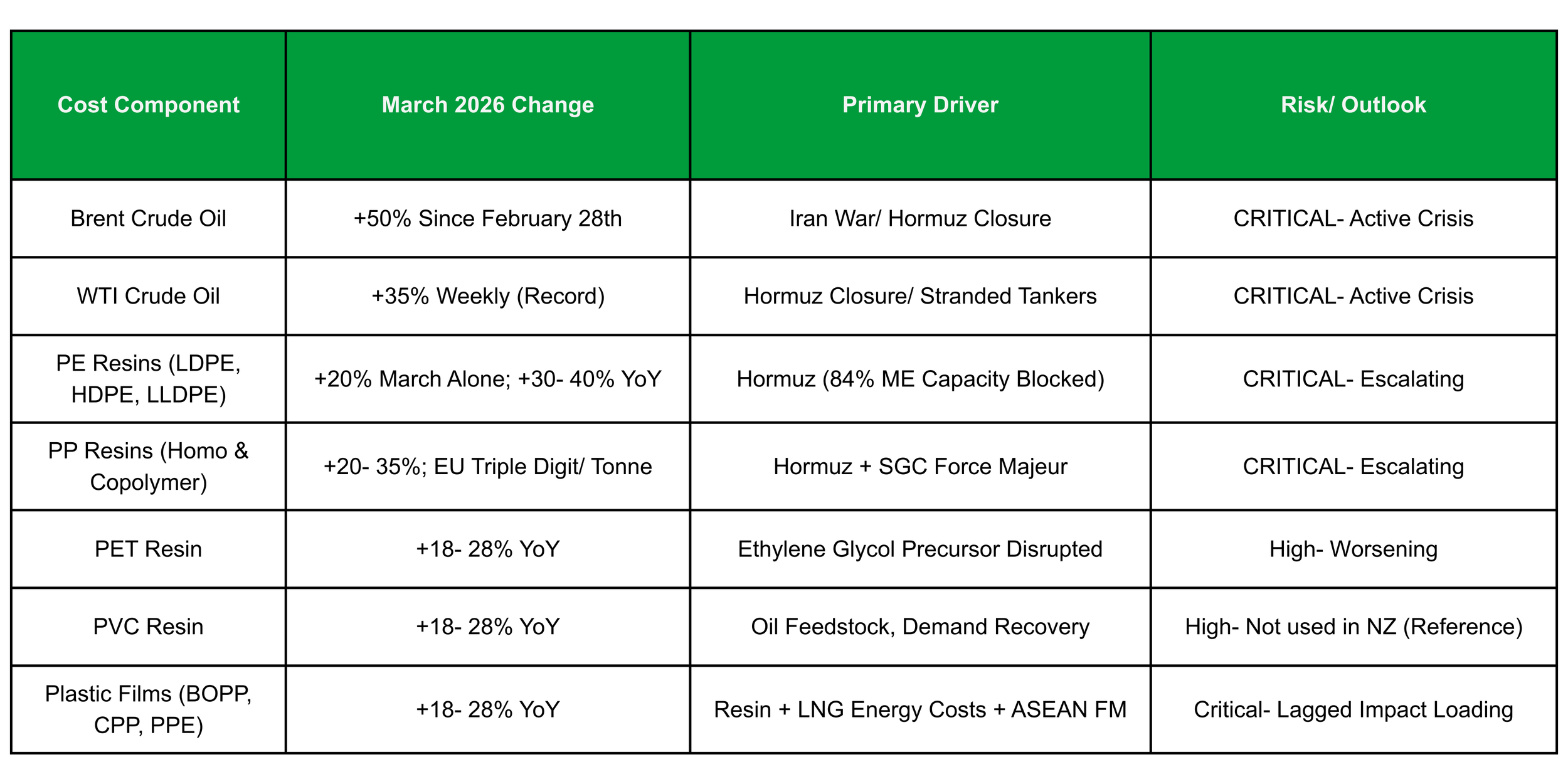
Take action and be preparedWe advise everyone needing packaging to reach out to their suppliers, have the difficult conversations, and prepare for what might come next. Be wary of not getting a price increase.
1
You may have time if you committed to stock holding on previous orders.
2Your supplier may have their own resin inventory, so only freight would be impacted.
3Ask the question and get the facts about price increases for both packaging and freight.
4Suppliers will often use existing conflicts to move packaging to cheaper manufacturing.
5Request, review, and compare COA’s and specs on all new orders against old.
Use our calculator to forecast potential costsOur calculator is set up to reverse engineer the pricing you have on hand. Revise any increases you are expecting and take full control over old versus new pricing.
Frequently Asked Questions-
Fair question. The Strait of Hormuz has been effectively closed since 28th February following U.S.-Israeli strikes on Iran. 20% of the world's oil and 37% of globally traded PE are impacted. Resin prices rose 20% in March alone; that is a fact, not a round number. This is a step-change that we cannot shield you from.
-
Genuinely uncertain. The U.S. Energy Secretary said “weeks, not months”, but as of today, strikes are ongoing, Iran is not negotiating, and the Hormuz closure remains active. Goldman Sachs projects that oil will remain elevated even in a quick-resolution scenario. We are planning for 4–8+ weeks of disruption minimum.
-
They will. These costs are universal across the entire global packaging supply chain. If a competitor is not reflecting this yet, they either haven’t caught up or they will issue a larger single increase later. We choose transparency over surprises.
-
No. Given a 20% resin increase in one month and further increases signalled, a price hold guarantee would be dishonest. What we can do is help you act quickly to lock in today’s pricing before the next round lands.
-
Absolutely, let us review your spec. We may be able to identify gauge reductions, structure simplifications, or alternative materials that will deliver cost savings to the current product without performance impact. These conversations are worth having, urgently given the direction of travel.
-
All data is based on publicly reported information current as of 10 March 2026, including: Reuters, CNBC, Al Jazeera, NPR, Axios, FreightWaves, Freightos, ICIS, Plastics Today, Plastics Machinery Manufacturing, Argus Media, Drewry, Trading Economics, Reserve Bank of NZ, Wikipedia (2026 Strait of Hormuz Crisis). The situation is actively evolving; we will update as new information becomes available. All percentage ranges are indicative; actual cost changes will vary by specific product, contract terms, sourcing origin, and exchange rate.
Press Release